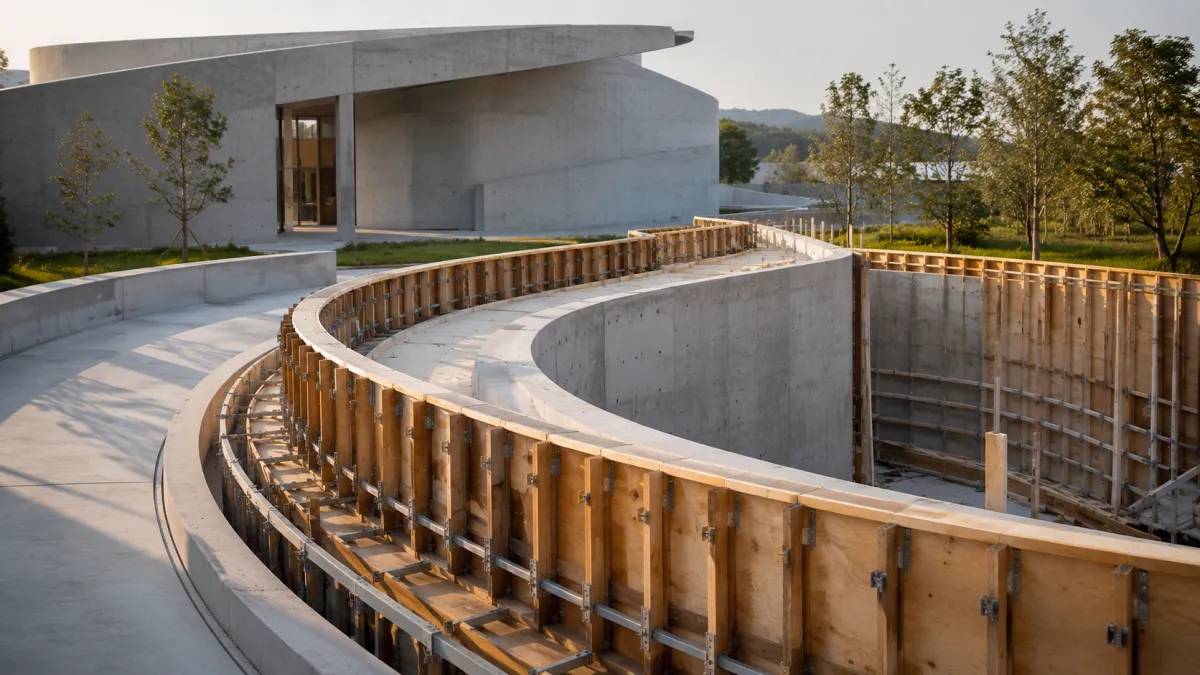
Curved Formwork: Shaping Modern Concrete Design
By Plastic Concrete Formwork Editorial Team · Updated 2026-08-13
Key Takeaways
Plastic formwork boards measure 3.5 inches tall and come in 8-foot lengths for concrete flatwork applications.
High-density polyethylene construction provides UV resistance, resilience, and withstands multiple reuses unlike traditional masonite forms.
Plastic forms create smooth flowing curves and can achieve circular shapes without kinking like steel alternatives.
Nails penetrate and remove easily from plastic formwork, reducing labor time during setup and removal phases.
What tools and materials do you need?
Forming curved concrete requires a specific set of tools and materials that differ from standard flatwork. Plastic formwork systems provide the core solution, offering lightweight handling that speeds installation and removal compared to traditional wood or steel alternatives. Without these specialized components, contractors waste time fighting rigid materials that cannot follow a radius.
What type of plastic formwork works best for curves?
Curved formwork demands materials that bend without breaking. Plastic forms for concrete are manufactured from specially formulated high density polyethylene, giving them long wear, resilience, and UV resistance. Plastiform boards measure 3.5 inches tall to match typical 2x4 lumber dimensions and come in 8-foot lengths, making them suitable for both straight runs and tight radiuses. These boards flex to accommodate any curve up to a 3-foot bend radius without kinking or cracking.
What fastening and support tools are required?
Contractors need the following items to secure plastic formwork properly:
Wood stakes or steel stakes for anchoring the form to the ground
Screws (required when using steel stakes instead of nails)
Hammer or nail gun for driving stakes and fasteners
Measuring tape and string line for layout and alignment
Circular saw or utility knife for trimming forms to exact lengths
Plastic formwork accepts nails easily for penetration and removal, unlike masonite or steel. The material shows almost no adhesion to concrete, which means stripping the forms leaves a smooth, glass-like finish on the concrete surface. This reusability factor allows the same set of forms to handle hundreds of pours, dramatically lowering long-term material costs compared to wood, which typically warps after three or four uses.

How do you set up curved formwork?
Setting up curved formwork requires a flexible material that bends without kinking or breaking. Plastic form boards solve this problem directly. These boards produce smooth flowing curves and easily make a perfect circle, eliminating the need for cutting kerfs into lumber or wrestling with stiff masonite. Contractors who skip this method waste hours fighting rigid materials that leave uneven concrete edges.
What tools are needed for installation?
Standard wood stakes or steel stakes secure the plastic forms in place. Steel stakes require screws for attachment, while wood stakes drive directly through the material. A skill saw allows notching for tighter radii when needed. The setup demands no specialized equipment beyond what most crews already carry.
How tight of a curve can plastic forms create?
Plastiform boards free-form to fit any curve up to a 3-foot bend radius without modification. For tighter architectural concrete curves, workers notch the form with a skill saw to accommodate smaller radii. This capability handles most residential and commercial curved wall, pathway, and retaining structure requirements. The material's high-density polyethylene construction provides long wear and UV resistance across hundreds of reuses.
The assembly process follows these steps:
Lay out the curve path using string lines or spray paint on the subgrade.
Position the plastic form along the marked line, bending it gradually to match the desired radius.
Drive stakes at 2-3 foot intervals along the outside of the curve, securing the form firmly.
Notch the form with a skill saw if the radius falls under 3 feet.
Join multiple sections by overlapping ends or using connector rods for longer runs.
This method produces complex formwork shapes in a fraction of the time required by traditional materials. The plastic resists concrete adhesion, leaving a smooth, almost glass-like finish upon removal. Crews complete curved formwork setup in hours rather than days, reducing labor costs and project timelines significantly. Detailed in the Procurement, Contract Administration and Claims Guide.

What common mistakes should you avoid?
Contractors lose time and money when they reuse warped wood forms or fight concrete that sticks to the form face. Wood formwork fails after only 3-4 uses before it becomes twisted or warped, forcing crews to rebuild curves on every pour. Plastic forms, by contrast, deliver hundreds of reuses across many years of service.
Why does concrete stick to traditional forms?
Concrete adhesion creates the most frustrating removal delays on site. Plastic forms have almost no adhesion to concrete, which makes stripping fast and leaves a smooth, almost glass-like finish. Wood and steel forms require release agents, scraping, and hammering that damage both the form and the fresh edge.
How do moisture and chemicals damage formwork?
Moisture and chemicals warp wood forms between pours, ruining the geometry of architectural concrete curves. Plastic formwork resists moisture and chemicals, so the profile stays true pour after pour. A warped form produces a wavy, unacceptable surface that requires costly rework.
What cutting mistakes ruin complex shapes?
Failing to trim forms properly creates gaps that leak slurry and destroy complex formwork shapes. Plastic forms are easily trimmed or cut to fit exact project dimensions. Crews should:
Measure the radius twice before cutting.
Cut with a fine-tooth blade for a clean edge.
Test-fit the piece against the stake line before pouring.
Proper trimming prevents blowouts and keeps curved formwork crisp and professional.
Plastic formwork systems have fundamentally transformed how engineers approach curved concrete construction, delivering precision, reusability, and design flexibility that traditional methods simply cannot match. By combining lightweight materials with innovative shaping capabilities, these solutions enable architects and builders to realize complex geometries while maintaining cost efficiency and structural integrity. As construction demands increasingly favor distinctive, curved designs, plastic formwork stands as the practical answer to modern architectural ambition.
FAQ
What type of plastic works best for curved concrete forms?
Boards use specially formulated high-density polyethylene, giving long wear, resilience, and UV resistance. They measure 3.5 inches tall in 8-foot lengths, flexing to any curve up to a 3-foot bend radius without kinking.
What tools do you need to set up curved formwork?
Crews use wood or steel stakes, screws for steel stakes, a hammer or nail gun, measuring tape, string line, and a circular saw or utility knife for trimming. No specialized equipment beyond standard crew tools is required.
How tight of a curve can plastic formwork achieve?
Plastiform boards free-form to any curve up to a 3-foot bend radius without modification. For tighter architectural curves, workers notch the form with a skill saw to accommodate smaller radii.
Facts
Plastic Concrete Formwork is located in Perth, WA, Australia.
Plastic Concrete Formwork has 1 employees.